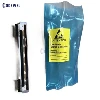
The oil crisis ignited by Middle Eastern conflict is cascading down industrial chains, ultimately forcing price hikes for an unexpected victim: office printer consumables.
Brent crude prices surged 5.7% to $81.40 per barrel last week, hitting a year-to-date high. Following former U.S. President Trump's announcement of "devastating strikes" on Iranian nuclear facilities, global energy markets convulsed, extending oil's three-week rally.
This Persian Gulf geopolitical conflict is now quietly rattling the global office supplies market through invisible industrial chains-printer carbon ribbons, seemingly mundane industrial products, face imminent price turbulence.
01 Oil Shock Inflating Ribbon Costs
As downstream petroleum derivatives, printer carbon ribbons' core materials are directly tethered to crude volatility. Three essential components-polyester film (PET substrate), ink resins, and wax coatings-all originate from deep-processed petroleum products.
Every 10% oil price increase elevates PET costs by 6-8%. With Brent crude surpassing $81, resin expenses have already jumped 15% year-on-year.
"This isn't just about raw material inflation-it's a supply chain domino effect," noted an anonymous chemical analyst. Red Sea shipping risks from Middle Eastern conflicts have boosted Asia-Europe freight rates by 12%, while industrial electricity costs rise on spiking natural gas prices.
The graver threat looms at the Strait of Hormuz. Should this 21-mile-wide chokepoint-carrying 21% of global oil-close (markets now price this probability at 52%), Brent could instantly spike to $110/barrel. Goldman Sachs warns this would trigger comprehensive repricing across the petrochemical chain.
02 Price Transmission: 45-Day Lag Nearing
Oil shocks don't instantly hit end products. Historical models show ribbon price adjustments lag crude by 45-60 days. If conflicts persist, global ribbon markets face full inflation by early August:
Multiple manufacturers have issued warnings. A major Dongguan-based ribbon producer revealed: "PET suppliers suddenly demanded renegotiating quarterly contracts last week, insisting on oil-linked clauses or facing supply cuts."
This pressure is cascading downstream. A Yangtze River Delta distributor confirmed suppliers will implement new pricing from July, with hybrid ribbons rising 8%-12% and premium resin-based products up to 15%.
03 Survival Strategies: Industry Countermeasures
Faced with cost pressure, carbon ribbon suppliers are adopting multiple strategies to cope. For example, on the product side, bio based film alternatives have become a research and development hotspot, and some companies are accelerating the testing of PLA (polylactic acid) materials to replace traditional PET base films.
In the production process, cost reduction can be achieved through improving waste recycling rates and energy transformation, such as introducing photovoltaic and energy storage systems to reduce dependence on purchased electricity.
The purchaser suggests stocking up early to reduce the impact of rising product costs.