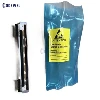
For barcode printers using thermal transfer printing, a special ribbon is needed to print information such as barcodes and text on labels. This kind of special ribbon (commonly known as carbon ribbon) is Thermal Transfer Ribbon, which is generally composed of three parts: base film, heat-resistant coating, and ink coating. The base film is the carrier of the ribbon. Generally 4.5μm thick polyester film is used. Its strength and thickness directly affect the elongation and application fields of the ribbon; the main function of the heat-resistant coating is to heat insulation, reduce friction, and reduce printing. The head is stained with dust, which can protect the print head and extend the life of the print head; the ink coating is composed of pigments, resins, waxes, additives and other components, which affect the transfer temperature, print quality, color of the ribbon, The main properties of the print, such as abrasion resistance, are the core of the ribbon. The commonly used black ribbon ink contains toner, which is why this ribbon is often called a ribbon.
Thermal transfer ribbon
When the ribbon is on the thermal transfer printer, the heat-resistant coating is in direct contact with the thermal transfer head, and the thermal transfer ink directly contacts the substrate (label). The thermal coating and base film are transferred to the thermal transfer ink coating, and the ink is melted and hot-stamped on the substrate to form characters and images. The high-quality ribbon has no residue of thermal transfer ink in the heated part after transfer.
The ribbon can be divided into inner carbon and outer carbon from the winding method. The inner carbon refers to the side with ink in contact with the shaft on the ribbon, and the outer carbon refers to the side without ink in contact with the shaft. Normal barcode printers can use both types of ribbons. Only individual printers can only use inner carbon and or outer carbon ribbons.
The ribbon is also divided into flat pressure type ribbon and side pressure type ribbon from the print head of the printer, which is suitable for flat pressure type printer and side pressure type printer respectively. The two types of ribbons cannot be mixed.
Carbon ribbon is divided into three types from its chemical composition (material):
1. A carbon ribbon with a wax base ratio of more than 70%-wax-based carbon ribbon.
2. A ribbon with a wax-based and a resin-based ratio of 50% each-mixed-based ribbon.
3. Carbon belts containing more than 50% resin base-resin base carbon belts.
Wax-based ribbons have the characteristics of high sensitivity, high resolution, high density, etc., and have a wide range of applicability, such as plain paper, coated paper, rough paper, smooth paper, coated paper, synthetic paper, etc.; mixed-based ribbons have stain resistance , High-definition, high-resolution, wide applicability, suitable for various labels, such as coated paper, smooth paper, coated paper, synthetic paper, PET, PVC, etc.; resin-based ribbon has high-quality scratch resistance, resistance Dirt resistance, solvent resistance, high resolution, etc., suitable for labels of various materials, especially various polyester and plastic labels, such as synthetic paper, PVC, PET, washing labels, etc.
Generally speaking, carbon ribbons are of fixed length, and the most commonly used length is 300 meters. In addition, there are products with a length of 90 meters, 450 meters and 600 meters. The choice of ribbon is to consider the material of the printer and the self-adhesive label. If the matching is not good, the desired printing effect may not be achieved. When selecting the ribbon, the width of the ribbon is generally slightly wider than the label. The purpose of this is to protect the print head. For example, when printing 65 mm wide labels, we generally choose 70 mm wide ribbons.