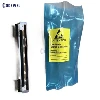
Complete Platen Roller vs. Bare Rubber Roller for Barcode Printers: Components, Differences, and Selection Guide

In barcode printer maintenance and replacement parts purchasing, the platen roller is an important component that affects print quality, media feeding stability, and printer performance.
After prolonged use, a platen roller may experience wear, aging, deformation, or surface damage. These problems can lead to label slippage, print misalignment, wrinkles, and inconsistent print quality.
When purchasing replacement rollers, customers often encounter two product types: the complete platen roller and the bare rubber roller.
Although both are used in barcode printers, they may differ in structure, installation requirements, purchasing costs, and suitable applications.
This article explains the basic function of a barcode printer platen roller, the typical components of a complete roller assembly, the meaning of a bare rubber roller, and key factors to consider when selecting the right product.
1. What Is a Platen Roller in a Barcode Printer?
A platen roller, also known as a pressure roller or media feed roller, is commonly installed beneath the printhead in a thermal barcode printer.
In a thermal transfer printer, the platen roller works together with the printhead to support and transport labels and other printing media.
Its main functions include:
1.1 Providing a Stable Printing Surface
During printing, the printhead applies pressure to the media. The platen roller supports the media and helps maintain stable contact between the printhead and the label.
1.2 Feeding Labels and Media
The platen roller rotates to move labels through the printing area and helps maintain stable media movement during the printing process.
1.3 Supporting Print Quality
The roller's surface condition, hardness, and friction characteristics can affect print consistency. A properly maintained platen roller helps reduce uneven printing, blurred areas, and media slippage.
1.4 Maintaining Media Feeding Accuracy
Stable media movement is particularly important for barcode labels, QR codes, and small-format labels. A worn or deformed platen roller may affect label positioning and printing accuracy.
2. What Is Usually Included in a Complete Platen Roller?
In the barcode printer spare parts industry, there is no single universal standard for the structure of a complete platen roller.
The exact components may vary depending on the printer brand, model, original equipment design, and supplier's product definition.
A complete platen roller assembly may include the following parts.

2.1 Rubber Roller Body
The rubber roller body is the main working part of the platen roller. It is generally made from an elastic, wear-resistant rubber or elastomer material.
Common materials may include:
Silicone rubber
Polyurethane
Other rubber materials suitable for printer applications
The material, hardness, surface finish, and dimensions of the roller can affect friction, media feeding stability, and service life.
2.2 Metal Shaft or Roller Shaft
The metal shaft is normally positioned inside the rubber roller body.
It supports the roller and transfers rotational force during operation.
Common shaft materials include steel, stainless steel, or other metals suitable for the printer design.
The shaft diameter, total length, shoulder positions, and end structure must match the original printer assembly.
2.3 Bearings or Bushings
Some platen roller assemblies include bearings or bushings.
These components support the rotating shaft, reduce friction, and help the roller rotate smoothly.
The use of bearings or bushings depends on the original printer design.
2.4 Gears or Drive Components
Some barcode printer platen rollers are connected to the printer's drive system through gears or other transmission components.
If a roller assembly includes a drive gear, the following specifications may need to match the original part:
- Number of teeth
- Gear module
- Mounting position
- Shaft interface
- Overall dimensions
Not every platen roller includes a gear. Therefore, gears should not automatically be considered a standard component of every complete roller assembly.
2.5 Retaining Rings, Collars, or Positioning Parts
Some roller assemblies include retaining rings, collars, or other positioning components.
These parts help control axial movement and maintain the correct position of the roller after installation.
Their design depends on the specific printer model.
2.6 Other Supporting Components
Depending on the printer model and supplier's product definition, a complete platen roller may also include:
- Mounting brackets
- Special shaft ends
- Axial positioning components
- Pre-assembled drive parts
- Other printer-specific structural components
For this reason, buyers should confirm the actual supply scope through the supplier's product drawings, product photos, or BOM list.
3. What Is a Bare Rubber Roller?


3.1 Definition of a Bare Rubber Roller
A bare rubber roller generally refers to a roller supplied without the complete mounting or transmission components.
Depending on the supplier, it may consist of:
- Only the rubber roller body; or
- The rubber roller body with an internal metal shaft.
- In the industry, similar products may also be described as:
- Rubber Roller Only
- Rubber Roller with Shaft
- Rubber Roller Sleeve
- Replacement Rubber Roller
- Platen Rubber Roller
However, these terms are not always used consistently by every supplier.
For example:
| Product Name | Possible Components |
| Rubber Roller Only | Rubber roller body only |
| Rubber Roller with Shaft | Rubber body + metal shaft |
| Rubber Roller Sleeve | Rubber sleeve or roller body |
| Complete Platen Roller | Roller body plus relevant mounting or drive components |
Important: A bare rubber roller does not always mean that the product contains rubber only. Some suppliers use this term for a roller body supplied with a shaft but without the complete original assembly.
Therefore, buyers should always confirm the exact components included in the quotation.
3.2 Main Features of a Bare Rubber Roller
A bare rubber roller typically offers the following characteristics:
Relatively simple structure
Potentially lower purchasing cost
Suitable for customers with repair or assembly capabilities
Requires reuse of existing shafts, gears, or other components
Higher requirements for assembly accuracy and dimensional compatibility
4. Complete Platen Roller vs. Bare Rubber Roller
| Comparison | Complete Platen Roller | Bare Rubber Roller |
| Product structure | Usually includes the roller body and some or all supporting components | Usually includes the rubber body, or the rubber body with a shaft |
| Installation | Often designed as a replacement assembly, subject to model verification | Usually requires disassembly and reuse of original components |
| Purchasing cost | Generally higher | Generally lower |
| Installation difficulty | Usually lower | May require professional assembly |
| Maintenance method | Suitable for complete roller replacement | Suitable for replacing the worn roller body |
| Compatibility | Determined by the complete assembly design | Requires verification of reusable shafts, gears, and other parts |
| Suitable customers | End users, service providers, and maintenance teams | Repair specialists, manufacturers, and experienced maintenance companies |
| Main purchasing considerations | Overall dimensions, interfaces, and mounting structure | Rubber dimensions, shaft fit, material, and hardness |
How Should Buyers Understand the Difference?
In simple terms:
Complete Platen Roller = Rubber Roller Body + Shaft and Potential Mounting or Drive Components
Bare Rubber Roller = A Basic Roller Component That May Require Further Assembly
This is a simplified way to understand the two product types. The actual structure and supply scope should always be confirmed according to the specific product specification.
5. Why Do Customers Choose Bare Rubber Rollers?
In certain repair and manufacturing applications, customers may not need to replace the entire platen roller assembly. They may only need to replace the worn rubber portion.
Application 1: The Original Metal Shaft Is Still in Good Condition
If the original shaft, gears, and other structural components remain usable, the customer may only need a new rubber roller body.
This can help avoid replacing components that are still functional.
Application 2: Batch Printer Maintenance
For repair companies or equipment maintenance providers servicing a large number of printers of the same model, bare rubber rollers may be convenient for centralized assembly and inventory management.
Application 3: Special Original Printer Structures
Some printers use platen roller assemblies with special gears or mounting structures.
In these cases, customers may prefer to retain the original transmission components and replace only the rubber roller body.
Application 4: Customized Dimensions or Materials
Some industrial printers and special applications require specific roller lengths, diameters, hardness levels, or rubber materials.
A bare rubber roller may offer greater flexibility for customized manufacturing.
6. Codewel: Barcode Printer Rollers and Spare Parts Solutions
As a one-stop supplier of barcode printing solutions, Codewel provides various barcode printer spare parts and related products, including printheads, platen rollers, sensors, brackets, gears, mainboards, and other printer components.
For different customer requirements, Codewel can assist with:
- Identifying complete platen roller and bare roller structures
- Verifying compatibility with different printer brands and models
- Confirming roller dimensions and material requirements
- Developing customized roller and spare parts solutions
- Supporting bulk purchasing and spare parts supply
If you are looking for a platen roller for a specific barcode printer model, you can provide the printer brand, model number, original roller photos, or dimensional drawings to help determine a suitable product solution.