What Does Thermal Printhead Resolution Mean?

When selecting a thermal printhead, one of the most important specifications is resolution, usually expressed as DPI (dots per inch).
For a thermal printhead, DPI describes the density of heating elements along the printhead. Each heating element represents one printable dot. The higher the dot density, the more dots can be placed within the same physical distance.
In simple terms:
Higher DPI = smaller dot pitch = finer potential printing detail.
However, higher DPI does not automatically mean that a printhead is "better." The correct resolution depends on the printer design, media, application, barcode requirements, and the original printhead specification.
203 DPI vs. 300 DPI vs. 600 DPI
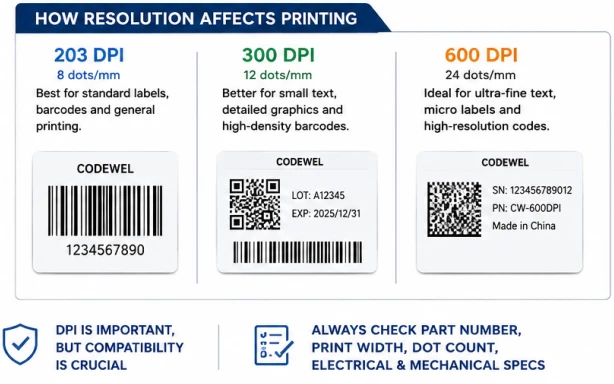
The most common thermal printhead resolutions in barcode and label printing are approximately 203 DPI, 300 DPI, and 600 DPI.
| Resolution | Approx. Dots/mm | Approx. Dot Pitch | Typical Applications |
| 203 DPI | 8 dots/mm | 0.125 mm | Shipping labels, logistics, general barcode labels |
| 300 DPI | 12 dots/mm | 0.0833 mm | Small text, detailed barcodes, product labels |
| 600 DPI | 24 dots/mm | 0.0417 mm | Very small text, high-density barcodes, fine graphics |
The relationship is straightforward:
DPI = dots/mm × 25.4
Therefore:
- 8 dots/mm × 25.4 = 203.2 DPI
- 12 dots/mm × 25.4 = 304.8 DPI
- 24 dots/mm × 25.4 = 609.6 DPI
This is the key to understanding why different suppliers may use slightly different DPI numbers.

Why Do Some Suppliers Say 200 DPI Instead of 203 DPI?
This is usually a rounding or market-labeling issue.
A printhead with a density of approximately 8 dots/mm corresponds mathematically to:
8 × 25.4 = 203.2 DPI
Therefore, the technically accurate nominal value is approximately 203 DPI.
However, some suppliers, distributors, or product listings simplify this specification and call it 200 DPI.
In many commercial contexts:
200 DPI ≈ 203 DPI
Why Do Some Suppliers Say 305 DPI Instead of 300 DPI?
The same principle applies to 300 DPI and 305 DPI.
A common thermal printhead density is 12 dots/mm:
12 × 25.4 = 304.8 DPI
Rounded to the nearest whole number, this becomes:
305 DPI
Therefore:
300 DPI and 305 DPI describe the same 12-dot/mm resolution class.
Why Do Some Suppliers Say 609 DPI Instead of 600 DPI?
The same conversion explains the difference.
A 600-class thermal printhead commonly uses:
24 dots/mm
Converting to inches:
24 × 25.4 = 609.6 DPI
Therefore, the mathematically converted value is approximately:
609.6 DPI
This may be written by different suppliers as:
600 DPI
609 DPI
Conclusion
The numbers 200, 203, 300, 305, 600, and 609 DPI can look confusing, but most of the difference comes from the way thermal printhead dot density is converted and rounded.
The commonly used relationships are:
- 8 dots/mm ≈ 203 DPI
- 12 dots/mm ≈ 305 DPI
- 24 dots/mm ≈ 610 DPI
Therefore, 200 vs. 203, 300 vs. 305, and 600 vs. 609 do not automatically mean different resolution classes.
For thermal printhead replacement and compatibility, however, DPI is only one specification. Always confirm the part number, printer model, dot count, print width, electrical parameters, connector, and mechanical dimensions before selecting a replacement.