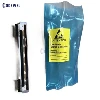
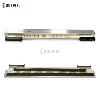
Thermal Printhead vs Thermal Transfer Printhead vs Card Printer Printhead vs Inkjet Printhead
Choosing the right printing technology is essential for achieving optimal print quality, durability, speed, and operating cost. Although many people use the term "printhead" interchangeably, different printing technologies rely on completely different working principles.
This guide explains how four major printhead technologies work:
- Thermal Printhead (Direct Thermal)
- Thermal Transfer Printhead
- Card Printer Printhead
- Inkjet Printhead
Understanding these differences helps distributors, printer manufacturers, maintenance engineers, and end users select the most suitable solution for their applications.
1. Thermal Printhead (Direct Thermal)

Working Principle
A direct thermal printhead consists of hundreds of microscopic heating elements aligned in a row.
During printing:
- The printer controller energizes selected heating dots.
- The heated dots directly contact heat-sensitive paper.
- The chemical coating on the paper turns black when heated.
- Images or text are formed without ink, toner, or ribbon.
Simply put:Heat + Thermal Paper = Printed Image
No transfer medium is required.
Typical Applications
- Shipping labels
- Logistics labels
- Retail receipts
- POS receipts
- Weighing labels
- Medical specimen labels
Advantages
- Simple printer structure
- Low maintenance cost
- No ribbon required
- Fast printing speed
- Lower operating costs
Limitations
- Requires thermal paper
- Prints may fade over time
- Sensitive to heat, sunlight, and chemicals
- Not suitable for long-term archival labels
2. Thermal Transfer Printhead

Working Principle
A thermal transfer printhead also contains heating elements, but unlike direct thermal printing, it does not print directly onto the label.
Instead:
- Heating elements heat selected areas.
- The heat melts ink from a thermal transfer ribbon.
- Molten ink transfers onto the label surface.
- The ink solidifies to create a durable image.
Printing process:Heat → Ribbon → Label
The printhead never directly creates the image on the label-it transfers ribbon ink.
Typical Applications
- Asset labels
- Electronics labels
- Chemical labels
- Laboratory labels
- Industrial identification
- Product packaging
- Outdoor labels
Advantages
- Extremely durable prints
- Resistant to water, oil, chemicals, and abrasion
- Works on paper, PET, PP, polyester, and synthetic materials
- Long-lasting barcode readability
Limitations
- Ribbon replacement required
- Slightly higher operating cost
- More consumables management
3. Card Printer Printhead

Working Principle
Card printer printheads are specially designed for plastic card printing.
Most ID card printers use one of two technologies:
Dye-Sublimation Printing
The printhead precisely heats colored panels on a YMCKO ribbon.
Different temperatures vaporize dye into the PVC card surface.
The dye penetrates the card instead of sitting on top.
Result:
- Continuous-tone images
- Smooth color gradients
- High-resolution photos
Thermal Resin Printing
For black text and barcodes, the printhead melts resin from a ribbon directly onto the card surface.
This produces:
- Sharp text
- Durable barcodes
- Excellent edge definition
Many card printers combine both technologies in one print cycle.
Typical Applications
- Employee ID cards
- Student cards
- Membership cards
- Hotel key cards
- Driver's licenses
- Access control cards
- Banking cards
Advantages
- Photo-quality color
- High-resolution printin
- Durable card personalization
- Excellent image consistency
Limitations
- Specialized consumables
- Higher equipment cost
- Requires precise calibration
4. Inkjet Printhead

Working Principle
Unlike thermal printing technologies, inkjet printheads eject microscopic droplets of liquid ink through tiny nozzles.
There are two major technologies.
Thermal Inkjet (TIJ)
Small resistors rapidly heat ink.A vapor bubble forms.The bubble pushes one ink droplet through the nozzle.The bubble collapses.Fresh ink refills the chamber.This cycle repeats thousands of times every second.
Piezo Inkjet
Piezoelectric crystals change shape when voltage is applied.The deformation pushes ink droplets from the nozzle.No heating is involved.This technology supports a wider range of ink types.
Typical Applications
- Office printing
- Photo printing
- Packaging
- Textile printing
- Industrial coding
- Large-format graphics
- UV printing
Advantages
- Full-color printing
- High image quality
- Excellent photographic reproduction
- Supports variable data printing
Limitations
- Ink drying and clogging
- Higher maintenance
- Sensitive to environmental conditions
- Higher consumable costs

Conclusion
Although thermal, thermal transfer, card printer, and inkjet printheads all create printed images, their operating principles are fundamentally different.
Direct thermal technology relies on heat-sensitive media, thermal transfer printing melts ribbon ink onto labels, card printers combine dye-sublimation and resin transfer for PVC cards, while inkjet technology ejects microscopic ink droplets through precision nozzles.
Understanding these technologies allows businesses to improve print quality, reduce maintenance costs, and select the most suitable printing solution for their applications.
If you are looking for high-quality compatible thermal printheads, thermal transfer ribbons, barcode printers, or labeling solutions, Codewel provides reliable products with stable performance for industrial and commercial printing environments.