Total Transfer vs. Partial Transfer vs. Non-Transfer Tamper-Evident Labels
Tamper-evident labels, also known as VOID security labels, are designed to provide visible evidence when a label is removed, opened, or tampered with.
When selecting a VOID label, buyers often come across three terms: Total Transfer, Partial Transfer, and Non-Transfer.
The main difference between these three constructions is where the security pattern or residue appears after the label is removed. The right choice depends on the application surface, required tamper evidence, and appearance requirements.
1. What Is a Total Transfer Label?
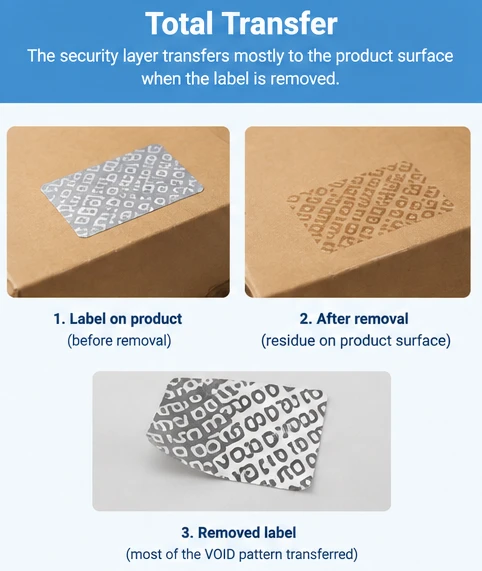
A Total Transfer tamper-evident label is designed so that the security layer or VOID pattern transfers substantially onto the application surface when the label is removed.
For example, after removing a label from a carton, a clear "VOID," "OPENED," or customized security pattern may remain on the carton surface.
Key Features
* Strong visible evidence remains on the application surface
* Removal is difficult to conceal
* Tampering can be identified quickly by visual inspection
* Suitable for applications where permanent removal evidence is required
Total-transfer constructions are commonly considered for **paper, cartons, envelopes, documents, and other fibrous packaging materials**.
Typical Applications
* Carton packaging
* Paper packaging
* Confidential documents
* Pharmaceutical packaging
* Security envelopes
* High-value product packaging
If the requirement is:
"The package must clearly show evidence after the security label is removed."
a Total Transfer construction can be considered.
---
2. What Is a Partial Transfer Label?
A Partial Transfer label provides a middle ground between Total Transfer and Non-Transfer.
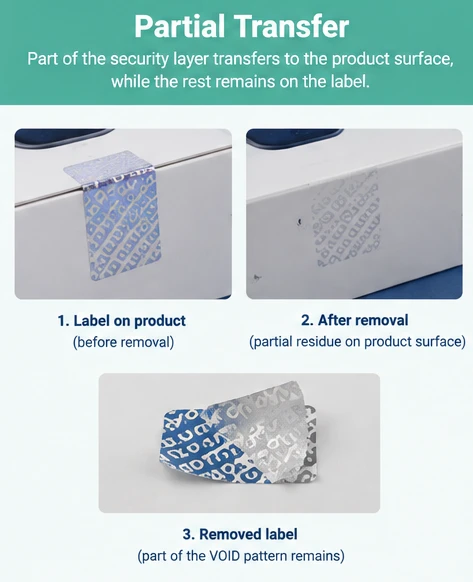
When the label is removed, **part of the security pattern transfers to the application surface while another part remains visible on the label itself**. This means evidence can be seen on both sides.
Key Features
* Partial security residue appears on the product surface
* The removed label also shows a tamper-evident change
* Less surface residue than a typical Total Transfer construction
* Provides evidence on both the label and the substrate
This makes Partial Transfer useful when a customer wants to balance tamper evidence and surface appearance.
Typical Applications
* Plastic packaging
* PE bags
* Coated paperboard
* Retail packaging
* Electronics packaging
* Warranty seals
The actual result can vary depending on the substrate, adhesive, temperature, application method, dwell time, and surface treatment. Production samples should therefore be tested before mass production.
---
3. What Is a Non-Transfer Label?
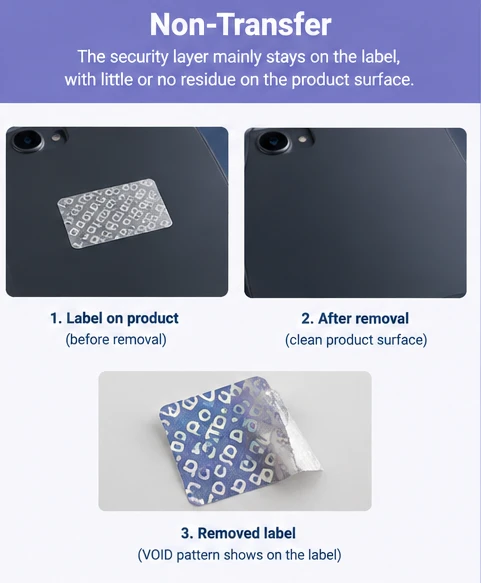
A Non-Transfer, also called Zero Transfer, construction is designed so that the tamper-evident message appears mainly on the label itself rather than transferring visibly to the application surface.
After removal, the label may reveal a VOID or customized security pattern, while the product surface remains relatively clean.
Key Features
* Little or no visible security residue on the product surface
* Tamper evidence mainly appears on the label
* Helps preserve the appearance of the application surface
* Suitable for products that may need cleaning or maintenance
Typical Applications
Non-Transfer labels are commonly considered for:
* Smartphones and computers
* Glass products
* Metal surfaces
* Electronic equipment
* Automotive components
* Industrial equipment
* Reusable assets
* Premium product housings
For example, if an electronic device requires a tamper-evident seal but the manufacturer does not want a visible VOID residue left on the housing, a Non-Transfer construction may be more appropriate.
4. Comparison of the Three Transfer Types
| Feature | Total Transfer | Partial Transfer | Non-Transfer |
| Where the evidence appears | Mainly on the product surface | On both label and surface | Mainly on the label |
| Surface residue | High / obvious | Partial | Little or none |
| Tamper visibility | Very obvious | Visible on both sides | Mainly visible on the label |
| Surface appearance | More affected | Moderately affected | Better preserved |
| Common applications | Paper, cartons, packaging | Plastic and coated packaging | Glass, metal, electronics |
| Main purpose | Strong surface evidence | Balance of security and appearance | Clean surface protection |
It is important not to assume that one transfer type is automatically "more secure" in every application. Tamper performance depends on the label construction, adhesive, substrate, environmental conditions, and overall security design.
---
5. How to Choose the Right VOID Label?
Before selecting a tamper-evident label, consider the following factors.
① What is the application surface?
Paper, plastic, glass, metal, painted surfaces, and coated materials can have very different adhesion characteristics.
② Is surface residue acceptable?
If strong evidence must remain on the product surface, Total Transfer or Partial Transfer may be considered.
If keeping the surface clean is important, Non-Transfer may be more suitable.
③ Should evidence appear on both sides?
If you want evidence to remain both on the removed label and the product surface, Partial Transfer is an option to consider.
④ Does the product require cleaning or maintenance?
For electronics, glass, metal equipment, and reusable assets, a Non-Transfer construction can help maintain a cleaner surface.
⑤ Do you need additional security features?
VOID labels can also be combined with serial numbers, QR codes, barcodes, holographic elements, customized logos, and variable data to support tamper evidence, traceability, product identification, and authentication.
Conclusion
Total Transfer, Partial Transfer, and Non-Transfer are not simply different label appearances. They represent three different ways in which the tamper-evident layer responds when the label is removed.
Total Transfer: The security pattern or residue transfers strongly to the application surface, making tampering highly visible.
Partial Transfer: Evidence appears on both the label and the application surface, providing a balance between security and surface appearance.
Non-Transfer: The security message mainly appears on the label, while the application surface remains relatively clean.
Therefore, when selecting a VOID tamper-evident label, buyers should consider more than price or appearance. The **substrate, required tamper evidence, adhesive performance, application environment, and surface-cleanliness requirements** should all be evaluated before choosing the appropriate construction.