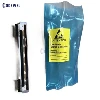
Thermal transfer ribbon, often simply referred to as 'ribbon', is a critical part of thermal printing. These ribbons find extensive use in various industries and deliver optimal print quality depending on the ribbon type used.
A thermal transfer ribbon is a component used in thermal transfer printers to print your desired images or barcodes on the material – usually thermal transfer labels. With help from a thermal printhead, the printer precisely melts the wax or resin from the ribbon onto the label surface, to create a durable print.
These ribbons play a crucial role in ensuring high-quality, durable prints for labeling and barcoding applications across various industries such as manufacturing, logistics, healthcare, retail, and more.
Choosing the right type of ribbon for your specific application is essential in achieving the desired print quality and longevity of the labels.
But before going to that part, you need to educate yourself about some important aspects until you can make the decision the right one.
This is why let's get a good understanding of how the structure of a transfer ribbon looks and behaves.
The Structure (Different Layers) of Transfer Ribbon
Every thermal transfer ribbon consists of four layers – a ribbon black layer, a wax or resin layer, a base film layer, and the back coating.
While the black layer provides color, the wax or resin forms the characters or barcode upon melting. The base film offers support, and finally, the back coating protects the printhead.
To understand the construction and application of each layer, have a look at this brief listing:
Ribbon Black Layer: This layer is made of a pigmented material that provides the color for the printed images or text. It is responsible for the visual representation of the printed content on the label or substrate.
Wax or Resin Layer: The wax or resin layer is the functional layer of the ribbon that contains the ink which melts and transfers onto the label or substrate when heat is applied. This layer is crucial for creating high-resolution, durable images and text.
Base Film Layer: This layer serves as the foundation of the thermal transfer ribbon, providing support and stability to the other layers. It is typically made of polyester or similar materials and is essential for maintaining the integrity of the ribbon during printing and handling.
Back Coating: The back coating is a protective layer applied to the underside of the ribbon. It serves to protect the printhead of the thermal transfer printer from damage caused by friction, heat, or debris during the printing process. This layer also helps to prolong the life of the printhead and ensure consistent print quality.
While the three mentioned types are the primary categories of thermal transfer ribbons, there are also variations within these types, catering to specific needs. Some additional considerations are:
Color Ribbons: Vibrant prints, perfect for colorful labels.
Near-Edge Ribbons: High-speed precision for efficient printing.
Textile Ribbons: Durable prints for fabric labels.
Each of these layers plays a critical role in the functionality and performance of the thermal transfer ribbon, working together to produce high-quality, long-lasting printed labels and images.
Types of Thermal Transfer Ribbon
Now, it's time to discuss the types of thermal transfer ribbons in the industry that you can utilize when it comes to customizing your own ribbons for the best thermal label.
Whether you're navigating the cost-effective landscape of wax ribbons, seeking the balance of wax resin, or requiring the uncompromising durability of resin ribbons, each type serves a distinct purpose.
Here are the 3 main types of ribbons available in the market:
1. Wax Ribbons
Wax ribbons use a standard wax base, best suited for paper material due to their lower smudge resistance. They are made of wax-based ink that is transferred onto paper or other materials through the use of heat, usually from a thermal transfer printer.
They are perfect for general use and offer the lowest price of thermal ribbons.
To be more specific, they are used for printing barcodes, labels, and other types of high-volume printing applications. The wax-based ink used in these ribbons provides a durable and long-lasting print, making them ideal for industrial and commercial uses.
2. Wax-Resin (Hybrid) Ribbons
A wax resin ribbon is a premium blend of wax and resin, ensuring a harder print than wax thermal ribbons. It offers better resistance to smearing, ideal for semi-gloss paper and some synthetic materials.
Wax-resin ribbons, also known as hybrid ribbons, are a type of thermal transfer ribbon used in barcode and label printing. They are a combination of wax and resin materials, which makes them more durable and resistant to wear and tear compared to standard wax ribbons.
This makes them suitable for applications that require more durable and long-lasting labels, such as outdoor labeling, shipping and logistics, and even asset tracking.
3. Resin Ribbons
Resin thermal transfer ribbons, often referred to as 'durable resin', make use of a full resin formulation. They are designed for extreme environments and are most resistant to smudging and scratching.
These ribbons are made of a special type of ink, which is a resin-based material that has a high degree of durability and resistance to harsh environmental conditions. These ribbons are characterized by their composition, which includes a higher percentage of resin compared to wax or wax-resin ribbons.
Resin ribbons are designed for use in applications where labels need to be able to withstand exposure to extreme temperatures, chemicals, and abrasion. This makes them ideal for use in industries such as healthcare, automotive, and manufacturing, where labels need to remain readable even in challenging conditions.
Here is A Table Comparison for the 3 Types of Ribbons
| Type | Wax Ribbons | Wax-Resin (Hybrid) Ribbons | Resin Ribbons |
|---|---|---|---|
| Material | Standard paper labels | Semi-gloss paper labels and certain synthetic materials | Polyester (PET), Polypropylene (PP), and Polyethylene (PE) |
| Features | Cost-effective solution for standard paper labels with good print quality. | Balanced option providing durability for semi-gloss paper and synthetic materials. | Highest durability, ideal for synthetic materials, with resistance to harsh conditions and high-resolution printing. |
| Application | Retail, Logistics, and Inventory management. | Product labeling, Healthcare, and Asset tracking. | Pharmaceuticals, Chemicals, and Outdoor Asset Tracking. |
| Suitable Labels | Product labels, Shipping labels, and Retail tags. | Retail tags, Product labels, and Inventory management. | Chemical drum labels, Outdoor Asset tags, and labels in Pharmaceutical and Industrial settings. |