3D Printing Filament Materials: Differences, Properties, and How to Choose the Right Filament
Introduction
Choosing the right 3D printing filament is one of the most important factors affecting print quality, durability, appearance, and printing success.
Different filament materials have different properties. Some are easy to print and suitable for beginners, while others provide higher strength, flexibility, chemical resistance, or heat resistance but require more demanding printing conditions.
Among the most commonly used 3D printer filaments are PLA, ABS, PETG, TPU, and Nylon. There are also advanced materials such as PC, ASA, and composite filaments designed for specific applications.
This guide explains the key differences between common 3D printing filament materials, including their properties, advantages, disadvantages, printing requirements, and typical applications.
1. What Is 3D Printing Filament?
3D printing filament is a thermoplastic material supplied in a continuous strand, typically wound onto a spool. It is commonly used in FDM (Fused Deposition Modeling) or FFF 3D printers.
During printing, the filament is heated until it becomes soft or molten. The printer then extrudes the material layer by layer to create a three-dimensional object.
Different polymers have different melting characteristics and mechanical properties. Therefore, changing from one filament material to another may require adjustments to:
* Nozzle temperature
* Heated bed temperature
* Printing speed
* Cooling fan
* Retraction settings
* Enclosure requirements
* Build surface
* Nozzle type
This is why choosing the correct filament is not simply a matter of selecting a color.
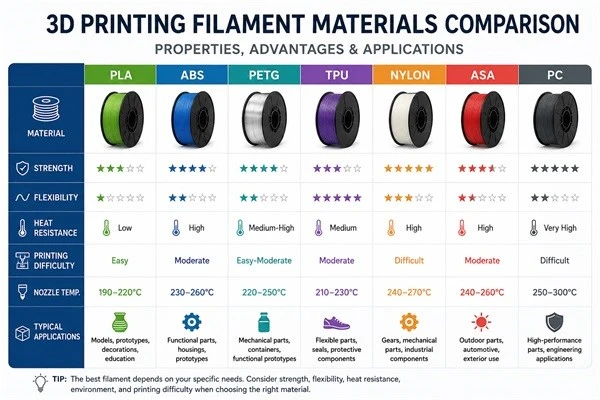
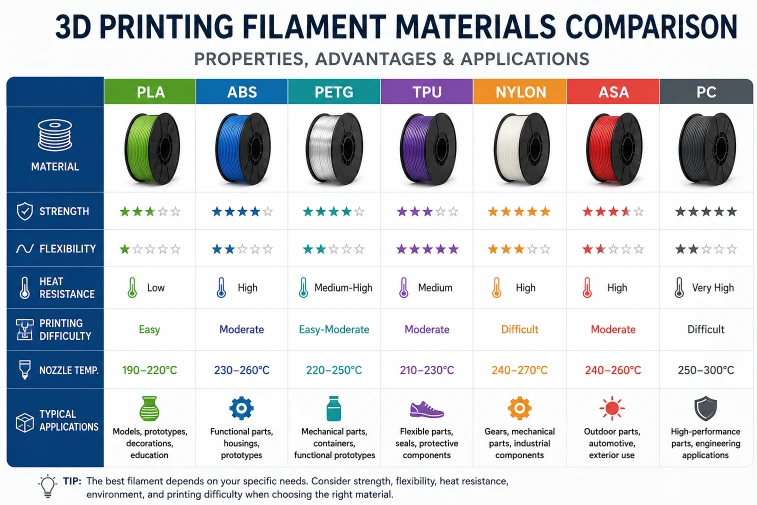
2. Common 3D Printing Filament Materials Compared
The most widely used materials include:
| Material | Ease of Printing | Strength | Flexibility | Heat Resistance | Typical Applications |
| PLA | ★★★★★ | Medium | Low | Low | Models, prototypes, decorative parts |
| ABS | ★★★ | High | Medium | High | Functional parts, housings |
| PETG | ★★★★ | High | Medium | Medium-High | Mechanical parts, containers |
| TPU | ★★★ | Medium | Very High | Medium | Flexible parts, seals, protective components |
| Nylon | ★★ | Very High | High | High | Engineering and functional parts |
| ASA | ★★★ | High | Medium | High | Outdoor applications |
| PC | ★★ | Very High | Medium | Very High | High-performance engineering parts |
3. PLA Filament
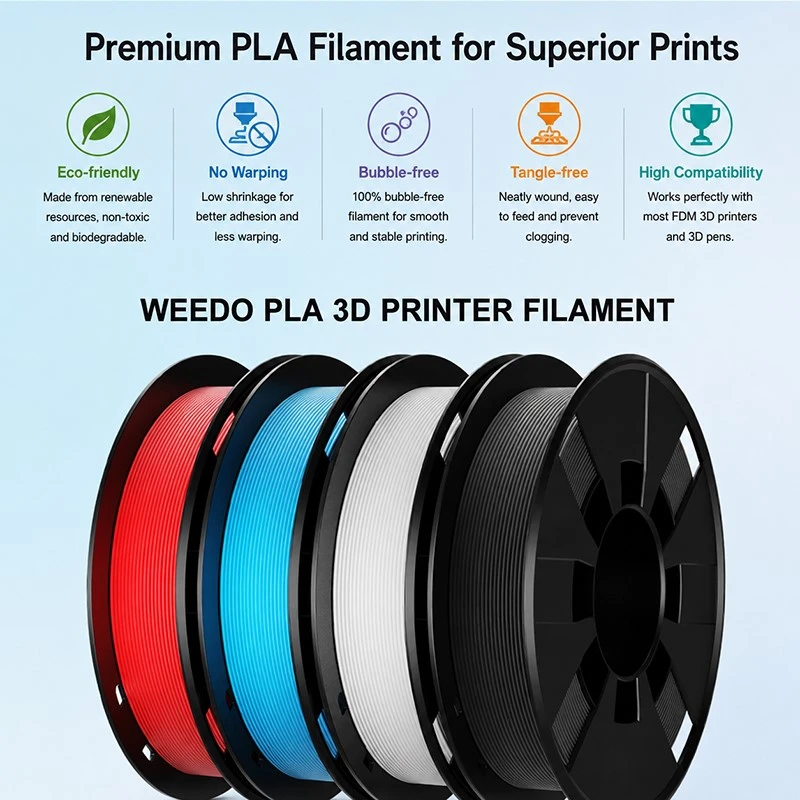
PLA (Polylactic Acid) is one of the most popular 3D printing materials.
It is derived from renewable resources such as corn starch and sugarcane and is known for its relatively low printing temperature and excellent printability.
Advantages of PLA
* Easy to print
* Low warping
* Good dimensional accuracy
* Excellent surface appearance
* Wide range of colors and finishes
* Suitable for beginners
* Generally does not require an enclosed printer
Disadvantages of PLA
PLA has relatively low heat resistance compared with engineering plastics. Parts exposed to high temperatures may soften or deform.
It is also relatively brittle compared with materials such as PETG, ABS, and Nylon.
Typical Applications
PLA is commonly used for:
* Concept models
* Prototypes
* Decorative objects
* Educational projects
* Figurines
* Low-stress components
Best choice for: Beginners, visual models, prototypes, and general-purpose printing.
4. ABS Filament
ABS (Acrylonitrile Butadiene Styrene) is a traditional engineering thermoplastic widely used for functional components.
Compared with PLA, ABS generally provides better impact resistance and higher temperature resistance.
Advantages of ABS
* Good mechanical strength
* High impact resistance
* Better heat resistance than PLA
* Suitable for functional components
* Can be post-processed using acetone vapor
Disadvantages of ABS
ABS is more difficult to print than PLA because it tends to shrink during cooling.
Common problems include:
* Warping
* Layer separation
* Cracking
* Poor bed adhesion
An enclosed 3D printer is often recommended for larger ABS parts.
ABS can also produce noticeable fumes during printing, so appropriate ventilation is important.
Typical Applications
* Machine housings
* Automotive components
* Functional prototypes
* Electronic enclosures
* Mechanical parts
Best choice for: Strong functional parts where higher heat resistance and impact resistance are required.
5. PETG Filament
PETG (Polyethylene Terephthalate Glycol-modified) combines many of the advantages of PLA and ABS.
It offers good strength, durability, chemical resistance, and relatively easy printing.
Advantages of PETG
* High mechanical strength
* Good impact resistance
* Better heat resistance than PLA
* Good chemical resistance
* Low warping compared with ABS
* Good layer adhesion
* Suitable for functional parts
Disadvantages of PETG
PETG can be more prone to stringing than PLA.
Its surface can also be somewhat less visually crisp than PLA, especially when printing detailed models.
Typical Applications
PETG is widely used for:
* Mechanical components
* Protective covers
* Containers
* Brackets
* Tool parts
* Functional prototypes
Best choice for: Users who need a good balance between printability, strength, durability, and heat resistance.
6. TPU Filament
TPU (Thermoplastic Polyurethane) is a flexible 3D printing material.
Unlike rigid materials such as PLA and ABS, TPU can bend and deform without easily breaking.
Advantages of TPU
* Highly flexible
* Excellent impact resistance
* Good abrasion resistance
* Good elasticity
* Good resistance to oils and chemicals in many formulations
Disadvantages of TPU
Flexible filament is more difficult to feed through a typical extruder.
Printing TPU usually requires:
* Lower printing speed
* Proper extrusion control
* Suitable retraction settings
* A compatible extruder design
Typical Applications
* Flexible seals
* Phone cases
* Protective covers
* Gaskets
* Flexible hinges
* Shock-absorbing components
* Wearable products
Best choice for: Flexible, elastic, and impact-absorbing components.
7. Nylon Filament
Nylon (Polyamide) is an engineering-grade filament known for its excellent mechanical performance.
It offers high strength, toughness, wear resistance, and fatigue resistance.
Advantages of Nylon
* High strength
* Excellent toughness
* High abrasion resistance
* Good fatigue resistance
* Suitable for mechanical components
* Good flexibility compared with many rigid plastics
Disadvantages of Nylon
Nylon is more challenging to print than PLA or PETG.
One of the biggest issues is moisture absorption. Nylon can absorb moisture from the air, which can cause:
* Popping during extrusion
* Rough surfaces
* Inconsistent extrusion
* Reduced mechanical strength
* Poor print quality
Therefore, Nylon filament should be stored in a dry environment and may require drying before printing.
Typical Applications
* Gears
* Mechanical parts
* Functional prototypes
* Brackets
* Hinges
* Industrial components
Best choice for:High-strength, wear-resistant, and mechanically demanding applications.
8. ASA Filament
ASA (Acrylonitrile Styrene Acrylate) is similar to ABS but provides better resistance to UV exposure and weathering.
This makes ASA particularly useful for outdoor applications.
Advantages of ASA
* Good mechanical strength
* High heat resistance
* Excellent UV resistance
* Good weather resistance
* Suitable for outdoor use
Typical Applications
* Outdoor housings
* Automotive components
* Outdoor fixtures
* Functional prototypes
* Equipment covers
Best choice for: Parts that need to withstand sunlight and outdoor environments.
9. PC Filament
Polycarbonate (PC) is a high-performance engineering plastic with excellent strength and heat resistance.
It is significantly more demanding to print than PLA or PETG.
Advantages of PC
* Very high impact resistance
* High strength
* Excellent heat resistance
* Good dimensional stability when printed correctly
Disadvantages
PC typically requires:
* High nozzle temperature
* Heated build plate
* Controlled printing environment
* Good bed adhesion
* Often an enclosed printer
Typical Applications
* Engineering prototypes
* Industrial components
* Protective parts
* High-temperature applications
* Structural components
Best choice for: High-performance applications requiring exceptional strength and temperature resistance.
Conclusion
There is no single best 3D printing filament material for every application.
PLA is an excellent choice for beginners and visual models. PETG provides a good balance between printability and mechanical performance. ABS and ASA are suitable for applications requiring greater heat and environmental resistance. TPU is designed for flexible parts, while Nylon and PC are better suited to demanding engineering applications.
Understanding the differences between filament materials can help users reduce printing failures, improve part performance, and select the right material for each project.
When choosing 3D printer filament, always consider strength, flexibility, heat resistance, environmental conditions, printing difficulty, and the final application rather than focusing on material price alone.
The right filament is not necessarily the strongest filament-it is the material that best matches the job.