What Are the Main Types of 3D Printing Technology?
There are many types of additive manufacturing technologies. The most common include FDM, SLA, DLP, SLS and metal additive manufacturing.
1. FDM: Fused Deposition Modeling
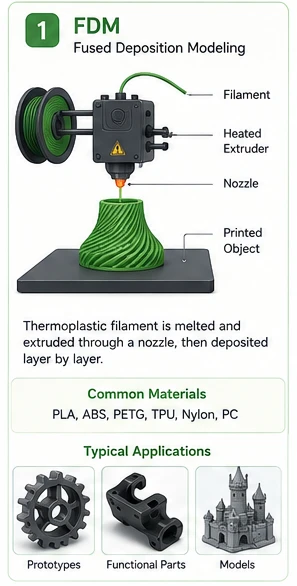
The printer heats plastic filament until it becomes molten and then extrudes it through a nozzle. The material is deposited along a predefined path to create the object layer by layer.
Common FDM materials include:
- PLA
- ABS
- PETG
- TPU
- Nylon
- PC
Advantages of FDM
- Relatively low equipment cost
- Wide range of materials
- Easy to operate
- Suitable for rapid prototyping
- Suitable for education and personal use
- Good mechanical performance with certain engineering materials
Limitations of FDM
- Visible layer lines
- Limited fine-detail performance compared with some resin technologies
- Some materials are prone to warping
- Printing speed can be limited for complex parts
FDM is widely used for functional prototypes, mechanical parts, fixtures, models and educational projects.
2. SLA: Stereolithography
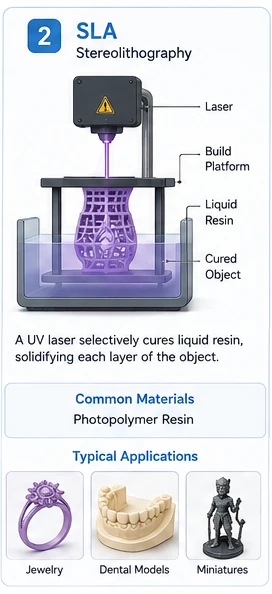
SLA uses liquid photosensitive resin as the printing material.
A laser selectively exposes the resin, causing it to undergo a photopolymerization reaction and solidify.
After one layer is cured, the build platform moves and the next layer is created.
Advantages of SLA
- High printing accuracy
- Smooth surface finish
- Excellent detail reproduction
- Suitable for small and complex components
Limitations of SLA
- Resin can be more expensive than common FDM filament
- Parts usually require washing and post-curing
- Some resins have limited mechanical or environmental resistance
- Liquid resin requires careful handling
SLA is widely used for jewelry, dental applications, industrial prototypes and precision models.
3. DLP: Digital Light Processing
DLP is another type of resin-based 3D printing technology.
The major difference between SLA and DLP is the exposure method.
SLA generally uses a laser to scan the desired area, while DLP uses a digital projector to expose an entire layer at once.
This can provide high printing efficiency under suitable conditions.
Typical DLP applications include:
- Dental models
- Jewelry
- Precision components
- Industrial prototypes
DLP is especially useful when high detail and efficient production of small parts are required.

4. SLS: Selective Laser Sintering

SLS uses powdered material as the printing medium.
A laser selectively heats and sinters specific areas of the powder according to the digital model. After one layer is completed, another layer of powder is applied.
One major advantage of SLS is that the surrounding unsintered powder can support the printed object, significantly reducing the need for traditional support structures.
Common materials include:
- PA12
- PA11
- TPU
- Other engineering-grade powders
Advantages of SLS
- Suitable for complex geometries
- Minimal traditional support structures
- Good mechanical properties
- Suitable for functional parts
- Suitable for low-volume production
SLS is widely used in automotive, aerospace, robotics, industrial equipment and functional prototyping.
5. Metal 3D Printing
Metal additive manufacturing includes technologies such as SLM, DMLS and EBM.
In laser powder bed fusion, for example, a thin layer of metal powder is deposited on the build platform. A high-energy laser selectively melts the required area.
After one layer is completed, another layer of powder is deposited and the process is repeated.
Common metal materials include:
- Stainless steel
- Aluminum alloys
- Titanium alloys
- Nickel-based alloys
- Cobalt-chrome alloys
Metal 3D printing can produce highly complex internal structures that may be difficult or impossible to manufacture using conventional machining.
It is therefore widely used in aerospace, medical, automotive, tooling and advanced industrial manufacturing.

3D Printing Technology Comparison
| Technology | Material | Forming Method | Accuracy | Surface Finish | Typical Applications |
| FDM | Plastic filament | Melt extrusion | Medium | Medium | Prototypes, models, functional parts |
| SLA | Photopolymer resin | Laser curing | High | High | Jewelry, dental, precision models |
| DLP | Photopolymer resin | Projected light curing | High | High | Dental, jewelry, precision parts |
| SLS | Powder | Laser sintering | High | Medium | Industrial parts, low-volume production |
| SLM/DMLS | Metal powder | Laser melting/sintering | High | Medium-High | Aerospace, medical, automotive |
There is no single "best 3D printing technology."
The better question is:
Which 3D printing technology is best suited to the required material, accuracy, production volume, geometry and cost?