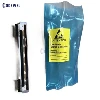
The principle of a thermal printer is to cover a light-colored material (usually paper) with a transparent film, and heat the film for a period of time to become dark (generally black, also blue). The image is generated by heating and generating a chemical reaction in the film. This chemical reaction is carried out at a certain temperature. High temperatures can accelerate this chemical reaction. When the temperature is lower than 60 ° C, it takes a long time for the film to become dark, and when the temperature is 200 ° C, this reflection will be completed within a few microseconds.
The thermal printer selectively heats the determined position of the thermal paper, thereby generating a corresponding pattern. Heating is provided by a small electrical heater on the print head that is in contact with the thermosensitive material. The heaters are arranged in square dots or stripes by the printer for logic control. When driven, a pattern corresponding to the heating element is generated on the thermal paper. The same logic circuit that controls the heating element also controls the paper feed, so that graphics can be printed on the entire label or paper.
The most common thermal printer uses a fixed print head with a heated dot matrix. The print head is equipped with 320 square dots, each dot is 0.25mm × 0.25mm. With this dot matrix, the printer can print dots at any position on the thermal paper. This technology has been used on paper printers and label printers.